Faith FAQ

5 comments
Faith FAQ

What do United Methodists believe?

For a complete overview of United Methodist beliefs, check out Who are United Methodists?

What is the difference between The United Methodist Church and a non-denominational church?

United Methodists are strengthened by a worldwide connection – 11.5 million members – that allows us to take action locally, regionally, and globally.  For instance, when the devastating earthquake struck Haiti in Jan. 2010, the church’s relief arm kicked into action.  It mobilized thousands of churches to create health kits, rapidly raised more than $1 million in direct relief aid, and sent teams of front-line responders to Haiti.  This network of people and churches allows us to advocate with a stronger voice on important policy matters, hold our pastors and leaders accountable, support major colleges and universities, and more.  We believe that we’re stronger together than we are alone.

What is the difference between United Methodists and groups like Baptists and Catholics?

Each of these groups is Christian and believes in the Bible.  Historically, both United Methodists and Baptists trace their roots to the Protestant Reformation, a 16th century doctrinal separation from the Roman Catholic Church.  United Methodists do not have a Pope figure; instead, a body of elected leaders – similar to the U.S. congress – convenes every four years to set the church’s priorities.  This organizational system differs from Baptists, whose congregations are more independent.  United Methodists have been known as a denomination strongly involved with people's lives and related struggles. This involvement is an expression of the personal change we experience when we become Christians.

How do United Methodists view non-Christian faiths?

United Methodists recognize that we’re not alone in this world and that it’s vital to strengthen inter-faith relationships through dialogue and action.  For example, United Methodists have adopted a resolution to work with Muslims “to address common problems and concerns.”  One result has been a partnership with British Muslim charities to provide aid to countries affected by disaster, poverty and conflict, such as Sri Lanka and Indonesia.

Is there diversity in The United Methodist Church?

Local churches mirror the communities in which we live.  Within our walls you’ll find United Methodists of every nationality, race, age, and background.  Our doors are open to everyone, and many churches have ministries which reach out specifically to groups that they believe have been shunned and overlooked by mainstream society.  The Get Involved section can help you find a local church based on needs that are important to you.

Does The United Methodist Church support political parties or candidates?

Look no further than two United Methodist First Ladies – Hillary Clinton and Laura Bush – to see that United Methodists are both Democrats and Republicans.  The United Methodist Church supports no single political party, but advocates on legislative issues that are core to our beliefs, such as women’s rights and addressing HIV/AIDS.  United Methodists from both sides of the aisle come together every four years to examine the beliefs and statements on which the church’s advocacy is based.  Every United Methodist has a voice in this process through his or her elected delegate.

What happens at a United Methodist church service?

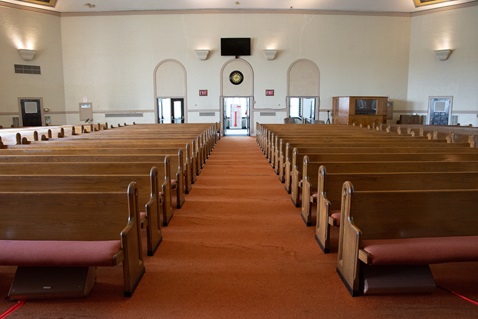
Our services are as diverse as our membership.  Typically an hour in length, United Methodist services include a sermon or message that expands upon a text within the Bible, as well as music.  Depending upon the church, the music can take many forms: from an organ, to a rock band, to a gospel choir – even among different services at the same church.  People dress in a variety of styles, and services might be offered in multiple languages.  Visit Get Involved to find a nearby service that might be right for you.

Am I expected to give money to the church, and is this part of its focus?

There is no requirement that a visitor contribute to the church.  However, members’ gifts enable the church to carry out its local mission – from providing meals to the homeless, to sponsoring literacy programs, to paying utility bills.  Additionally, United Methodist churches annually pool a small portion of the gifts that they receive so that the church can carry out work collectively, such as funding Africa University, Zimbabwe’s first private, international university.

How do I get answers to other questions?

For an expanded United Methodist FAQ, visit InfoServ.  You may also contact us directly or pose a question by starting a conversation below.  We are glad to help.

Originally Posted: Apr 27, 2011

Comments

Very glorious composition. With subject being so necessary online, this is a perfect outline for accomplish new on that people will use for thesis.
It's good that United Methodist tries to work with other religions too. I'm not religious myself but I have a girlfriend who is Buddhist, and most of the time that seems to be a problem for many, especially here where I live. Yonis

I was raised Methodist and this was really the only church I knew until I met my wife. She was Catholic so I decided to go to her church. After several years of marriage, I am still going to the Catholic church. Even with several trials in our marriage, like her parents dying and our pet Rascal having problems with dog allergies, our faith has brought us through. I think its great that even though we grew up with entirely different religions, our core beliefs are still the same.

Methodism started in 1744 as a split in the Anglican church. The Anglicans were not fond of evangalism and that caused the rift that lead to the Methodist denomination. The term holy rollers was first applied to the Methodist movement in the U.S. in the 1800's:my how times have changed!

I would kindly ask that you rephrase the association of Baptists with Protestantism in the section "What is the difference between United Methodists and groups like Baptists and Catholics?". It is a common misconception that Baptists split off from the Roman Catholic church as did Methodists and Lutherans. The local church as a body of believers began after the resurrection of Christ and the arrive of the Holy Spirit. Lineage is not as important as the free gift of salvation offered by the shed blood of Jesus Christ and his resurrection, for each person to individually accept.